


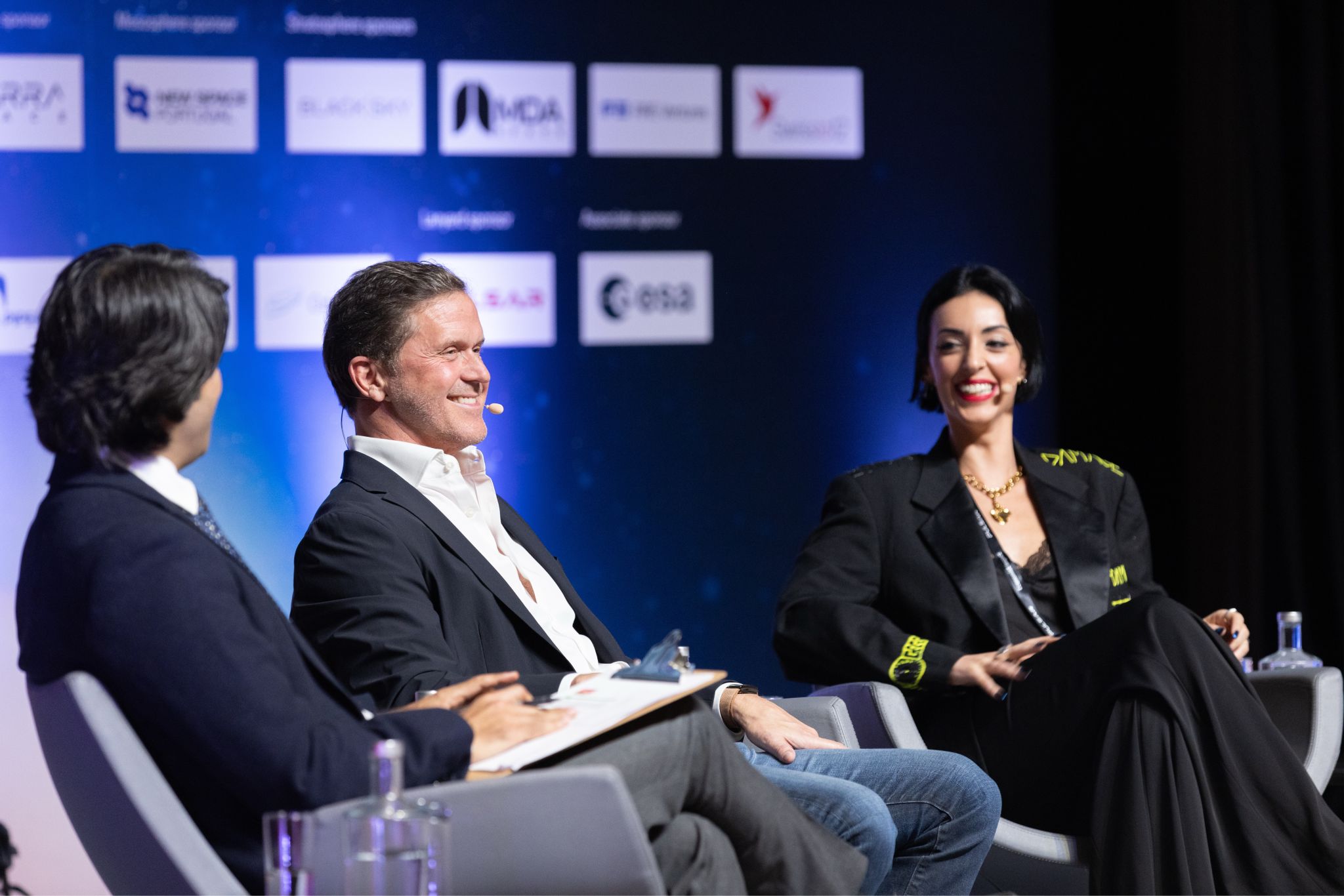

Last week, I found myself on The Economist Summit stage in Lisbon, engaging in what can only be described as productive science fiction speculation about humanity's future in space. Alongside Kelly Perdew and Barbara Belvisi, we explored scenarios that might sound like fantasy today but represent the inevitable trajectory of human expansion beyond Earth.
The conversation centered on in-orbit manufacturing—a concept that's rapidly transitioning from theoretical possibility to commercial reality. As someone who's spent over a decade grappling with the limitations of Earth-based space technology development, I've become convinced that our most transformative breakthroughs won't happen in terrestrial facilities, but in the unique environment of space itself.
Decoupling Manufacturing from Earth's Ecosystem
The environmental argument for space manufacturing is compelling and urgent. We're facing a sustainability crisis that demands radical solutions, not incremental improvements. Consider semiconductor manufacturing, which accounts for up to 75% of the global electronics industry's carbon footprint. These processes are energy-intensive, chemically complex, and environmentally destructive when conducted at scale on Earth.
But in microgravity, everything changes. The absence of gravitational forces eliminates the need for many energy-intensive processes used to maintain material purity. Crystals grow more uniformly, contamination decreases dramatically, and the resulting semiconductors demonstrate superior performance characteristics. We're not just talking about cleaner manufacturing—we're talking about better products that require fewer resources to produce.
This isn't speculative technology. Companies are already demonstrating proof-of-concept for orbital manufacturing platforms. What excites me is the potential scale: if we could relocate even a fraction of Earth's most polluting manufacturing processes to orbital facilities powered by abundant solar energy, we could achieve meaningful progress toward net-zero emissions by 2050.
The beauty of this approach is that it's not about sacrifice—it's about abundance. Space offers unlimited solar energy, perfect vacuum conditions, and microgravity environments that enable manufacturing processes impossible on Earth. We're not choosing between environmental protection and industrial capability; we're choosing both.
Orbital Pit Stops for Human Expansion
The second transformation involves reimagining space infrastructure as a self-sustaining ecosystem rather than an extension of Earth-based supply chains. Picture orbital factories that recycle decommissioned satellites, produce rocket fuel on demand, and assemble new components entirely in space. These aren't distant dreams—they're the logical next step in space commercialization.
These orbital servicing hubs would function as the pit stops of a closed-loop space economy, reducing our dependency on expensive Earth-to-orbit transportation for every component and consumable. The economics are straightforward: launching materials from Earth costs thousands of dollars per kilogram, but recycling and manufacturing in space eliminates that expense entirely.
NASA's Artemis program has already emphasized in-situ resource utilization for lunar operations, recognizing that sustainable space exploration requires local resource development. Orbital manufacturing extends this principle throughout the solar system, creating the infrastructure necessary for permanent human presence beyond Earth.
What particularly excites me about this vision is its inevitability. Once we establish the initial orbital manufacturing capacity, the economic advantages become self-reinforcing. Lower costs enable more ambitious projects, which justify additional infrastructure investment, which reduces costs further. We're approaching the tipping point where this cycle begins.
Engineering Enhanced Humanity
The third area of speculation ventures into more controversial territory: using space-manufactured materials to enhance human capabilities. This isn't about creating a privileged superhuman class—it's about democratizing human potential through technology.
Microgravity manufacturing enables the creation of biomaterials with properties impossible to achieve on Earth. Lighter, stronger, more adaptable materials that integrate seamlessly with human physiology. Consider prosthetics that don't just replace lost function but enhance it, providing capabilities beyond natural human limits.
The applications extend far beyond medical necessity. Imagine fabrics engineered in space that function as dynamic exoskeletons, improving strength, agility, and endurance for specific applications. Firefighters could operate safely in extreme environments, construction workers could manipulate heavy materials effortlessly, and athletes could achieve performances that seem impossible today.
This isn't about replacing humanity—it's about intentional human evolution. For the first time in our species' history, we possess the technology to direct our own development rather than leaving it to random genetic variation and environmental pressure.
The Inevitable Future
What struck me most during our Economist Summit discussion was the recognition that these scenarios aren't speculative luxury—they're necessary adaptations to humanity's expanding presence in space. As we establish permanent settlements on the Moon, Mars, and eventually other celestial bodies, we'll need manufacturing capabilities, sustainable resource cycles, and enhanced human performance to survive and thrive.
The question isn't whether these developments will occur, but how quickly we can make them reality. The companies and nations that master orbital manufacturing first will capture disproportionate advantages in the emerging space economy. Those that delay will find themselves dependent on others' infrastructure and capabilities.
At Space DOTS®, our environmental intelligence platforms will play a crucial role in enabling these transformations. Orbital manufacturing facilities will require unprecedented understanding of space environmental conditions to operate safely and efficiently. The same intelligence that helps today's satellites survive in orbit will guide tomorrow's orbital factories.
The future we discussed on that Lisbon stage isn't science fiction—it's the logical extension of current technological trajectories. We're not speculating about whether these capabilities will emerge, but planning for when they do.
Our destiny among the stars isn't just possible—it's inevitable. The only question is whether we'll lead the transformation or follow others who dare to build it.